

Distributed Acoustic Sensing (DAS), is a technique that turns common optical fibres into strain sensors with exceptionally fine spatial and temporal resolution, providing ultra-dense networks of sensors that can be deployed in challenging environments for a very low cost.
DAS operates by analysing the backscattering of laser light pulses travelling through optical fibres. Small density heterogeneities in the glass induce specific Rayleigh backscattering patterns that depend on the relative position of the imperfections. As the fibre is deformed, the geometrical arrangement changes, causing phase shifts in the backscatter. DAS is most sensitive to axial strain.
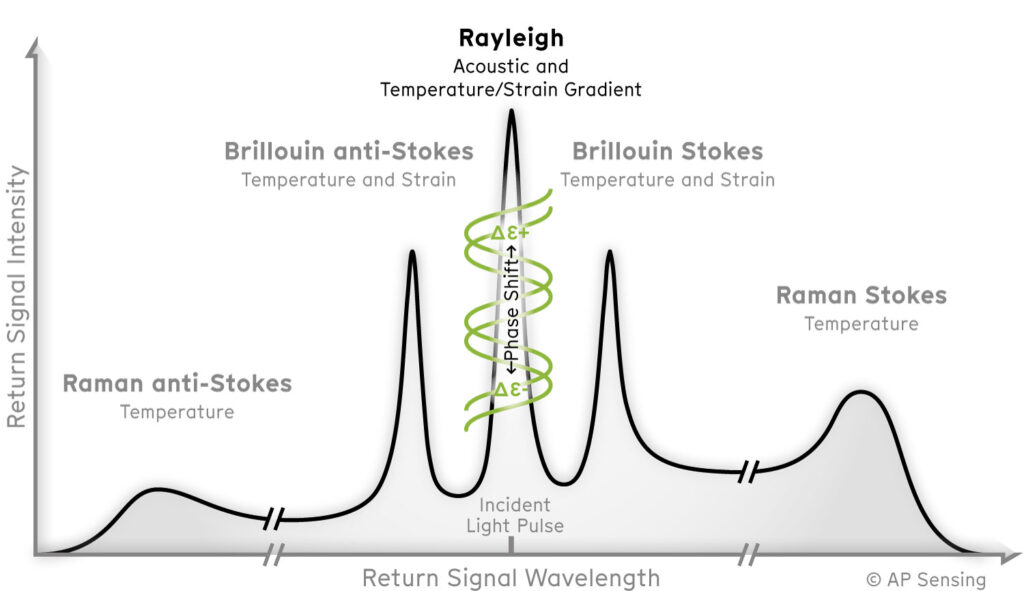
As the propagation velocity of light in glass is known, simple time-gating allows us to determine where the fibre is being deformed. Measures need to be averaged along finite lengths of the fibre, called gauge lengths, as the distribution of density heterogeneities is not known. Changes in the phase of the backscattered light are thus converted into strain or strain rate at each gauge length.
Typical gauge lengths vary from metres to tens of metres. Longer gauge lengths improve SNR, but introduce low-pass filtering that limits the maximum sampling frequency.
The system that sends light pulses and analyzes the backscatter is called an interrogator. There are two main types of DAS interrogators, pulsed systems, which send short pulses of light down the fibre, and chirped systems, which send a longer duration frequency sweep. The chirped systems have higher complexity, but longer ranges. Pulsed systems have shorter range as the intrinsic fibre attenuation limits the amount of light that reaches the interrogator. Higher transmission power does not help, as above a certain energy, light propagation enters a non-linear mode that prevents DAS from working.
Rayleigh-based DAS systems measure phase or phase rate variations that are converted into apparent strain measurements. These systems do not measure absolute strain, as they are inherently cross-sensitive to true strain, temperature, and pressure.
There are other types of fibre sensing interrogators, based on the Brillouin and Raman scattering. They are sensitive to strain and temperature, and temperature, respectively. Their range and sampling rates are lower than Rayleigh-based systems, due to the weaker scattering in these modes.