

Cetaceans around Madeira
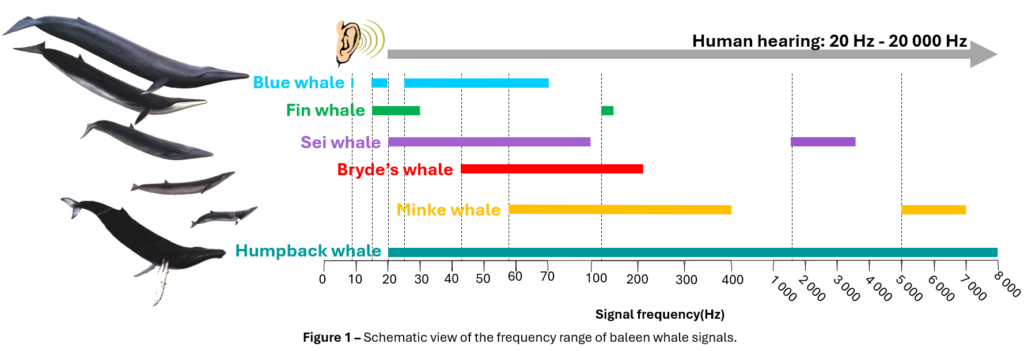
Cetaceans depend fundamentally on sound to interact with their environment. Acoustic signals in cetaceans are produced by different anatomical structures depending on the taxonomic group and the type of sound emitted, and they are crucial to behaviours such as navigation, foraging, reproduction, and social interactions. These signals range from short, discrete clicks or calls to prolonged sequences that may continue for hours. Because sound plays such a central role in the life of cetaceans, passive acoustic data also provide a powerful means to study their ecology. Acoustic recordings can be used to detect species presence, distinguish species and, in some cases, populations or individuals, and to infer spatial patterns when source distance can be estimated from the recorded signals. Depending on the species or taxonomic group, cetacean sounds vary substantially in frequency, intensity, duration, and temporal pattern. High-frequency signals are typical of many toothed whales, including dolphins, porpoises, and beaked whales, especially for echolocation. In contrast, very low-frequency sounds, often near or below the lower limit of human hearing, are mainly produced by baleen whales, some of which generate long and repetitive call sequences.
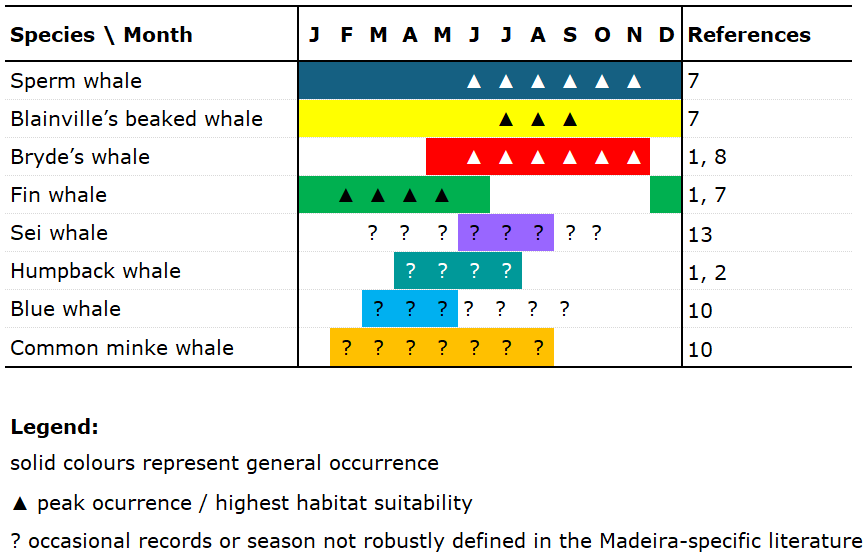
Around the Madeira archipelago, cetacean diversity is high, with nearly 30 recorded species, most of them odontocetes (toothed whales, dolphins and porpoises) with distinct habitat use and occurrence patterns (Freitas et al., 2026, 2012). These waters host several cetacean species of conservation concern, including Endangered species such as the Sei whale (Balaenoptera borealis), Vulnerable species such as the fin whale (Balaenoptera physalus) and the sperm whale (Physeter macrocephalus), and Data Deficient species such as Blainville’s beaked whale (Mesoplodon densirostris) and other poorly known offshore cetaceans (Alves et al., 2021). Among the most frequently recorded or sighted species are the common bottlenose dolphin (Tursiops truncatus), the short-finned pilot whale (Globicephala macrorhynchus), the Atlantic spotted dolphin (Stenella frontalis), the short-beaked common dolphin (Delphinus delphis), and the sperm whale (Physeter macrocephalus), with some species showing year-round occurrence and evidence of residency, while others display marked seasonal patterns (Alves et al., 2018; Dinis et al., 2016; Ferreira et al., 2022; Fernandez et al., 2021).
The two most frequently sighted deep-diving cetaceans in Madeira are the Sperm whale and Blainville’s beaked whale.
Of the 15 currently recognized baleen whale species worldwide, seven have been recorded in Madeira waters (IWC, 2018): Bryde’s whale, Sei whale, Humpback whale, Fin whale, Blue whale, and the Common minke whale.
References
- Alves, F., Ferreira, R., Fernandes, M., Halicka, Z., Dias, L. and Dinis, A., 2018. Analysis of occurrence patterns and biological factors of cetaceans based on long-term and fine-scale data from platforms of opportunity: Madeira Island as a case study. Marine Ecology, 39, 12499. https://doi.org/10.1111/maec.12499
- Alves, R., Fernandez, M., Cheeseman, T., Abreu, N., Martins, C., Moura, F., Scott, J., Thake, P., López-Suárez, P., Alves, F. and Ferreira, R., 2025. Humpback whale movements in the northeastern Atlantic: Madeira, a crossing point on the migration route. Aquatic Mammals, 5, 233–240. https://doi.org/10.1578/AM.51.3.2025.233
- Carrillo, M., Pérez-Vallazza, C. and Álvarez-Vázquez, R., 2010. Cetacean diversity and distribution off Tenerife (Canary Islands). Marine Biodiversity Records, 3, 1–9. https://doi.org/10.1017/S1755267210000801
- Correia-Fagundes, C. and Romano, H., 2013. Observation of a birth of a sperm whale Physeter macrocephalus at Madeira (NE Atlantic). Bocagiana, 236, 1–3.
- Dinis, A., Alves, F., Nicolau, C., Ribeiro, C., Kaufmann, M., Cañadas, A. and Freitas, L., 2016. Bottlenose dolphin Tursiops truncatus group dynamics, site fidelity, residency and movement patterns in the Madeira Archipelago (North-East Atlantic). African Journal of Marine Science, 38, 151–160. https://doi.org/10.2989/1814232X.2016.1167780
- Dinis, A., Marques, R., Dias, L., Sousa, D., Gomes, C., Abreu, N. and Alves, F., 2017. Site fidelity of Blainville’s beaked whale (Mesoplodon densirostris) off Madeira Island (Northeast Atlantic). Aquatic Mammals, 43, 387–390. https://doi.org/10.1578/AM.43.4.2017.387
- Fernandez, M., Dinis, A., Tobeña, M., Cañadas, A. and Alves, F., 2021. Modeling fine-scale cetaceans’ distributions in oceanic islands: Madeira archipelago as a case study. Frontiers in Marine Science, 8, 688248. https://doi.org/10.3389/fmars.2021.688248
- Ferreira, R., Dinis, A., Badenas, A., Sambolino, A., Marrero-Pérez, J., Crespo, A. and Alves, F., 2021. Bryde’s whales in the North-East Atlantic: new insights on site fidelity and connectivity between oceanic archipelagos. Aquatic Conservation: Marine and Freshwater Ecosystems, 31, 2938–2950. https://doi.org/10.1002/aqc.3665
- Ferreira, R., Steiner, L., Martín, V., Fusar Poli, F., Dinis, A., Kaufmann, M., Fernandez, M. and Alves, F., 2022. Unraveling site fidelity and residency patterns of sperm whales in the insular oceanic waters of Macaronesia. Frontiers in Marine Science, 9, 1021635. https://doi.org/10.3389/fmars.2022.1021635
- Freitas, L., Dinis, A., Nicolau, C., Ribeiro, C. and Alves, F., 2012. New records of cetacean species for Madeira Archipelago with an updated checklist. Boletim do Museu Municipal do Funchal, 62, 25–43. PDF
- Freitas, L., Ribeiro, C., Carvalho, A., Cañadas, A. and Hammond, P.S., 2026. Estimates of abundance and predicted distribution of the main cetacean species in Madeira Archipelago inshore waters for 2007–2012. Marine Mammal Science,e70065. https://doi.org/10.1111/mms.70065
- Freitas, L.A.A., 2024. The ecological importance of oceanic islands for cetaceans: the case study of Madeira archipelago. PhD thesis. University of St Andrews. https://doi.org/10.17630/sta/893
- International Whaling Commission, 2018. Whale watching handbook. Online resource. https://wwhandbook.iwc.int/en/country-profiles/portugal
- Steiner, L., Silva, M.A., Zereba, J. and Leal, M.J., 2008. Bryde’s whales, Balaenoptera edeni, observed in the Azores: a new species record for the region. Marine Biodiversity Records, 1, e66. https://doi.org/10.1017/S1755267207007282