

Seismicity
Even though DAS cables only provide one component, marine deployments give us access to areas that we were previously unable to monitor with seismic stations, unless rather expensive OBS (ocean-bottom seismometer) experiments were carried out in the location. In addition, they provide them at an unprecedented spatial density. Because of this density, it is possible to easily recognise features that would be very hard or even impossible to observe with single seismic stations.
T-Waves
A recording of a local event (generated east of the Desertas Islands at less than 50 km distance to the cable) gave not only the expected P and S phases, but also a T phase (see Figure below). The T phase is generated when seismic energy is transmitted from the ground into the water column and kept there over sometimes very large distances in the SOFAR channel, a low velocity “valley” in the water where energy is channelled. Normally, T-waves are not recorded so close to the epicenter, as they require a seafloor topography with characteristics typically found only on ocean ridges, far from seismic stations.
In this instance, due to the topography around the small islands between the event and the cable, seismic energy could be transmitted from the flanks of the islands into the water column and from there straight away to the cable.
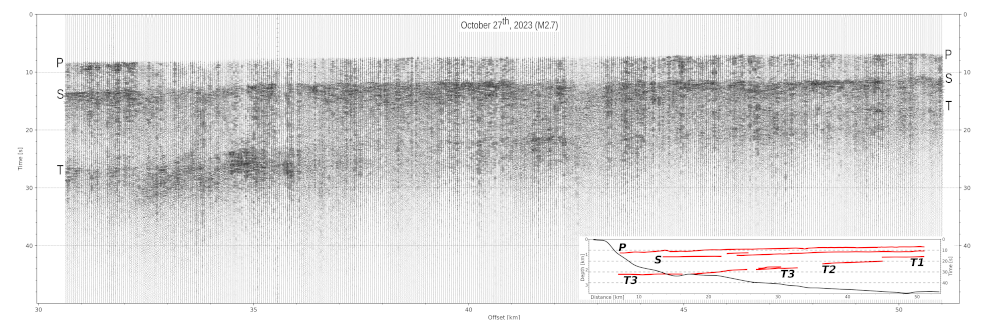
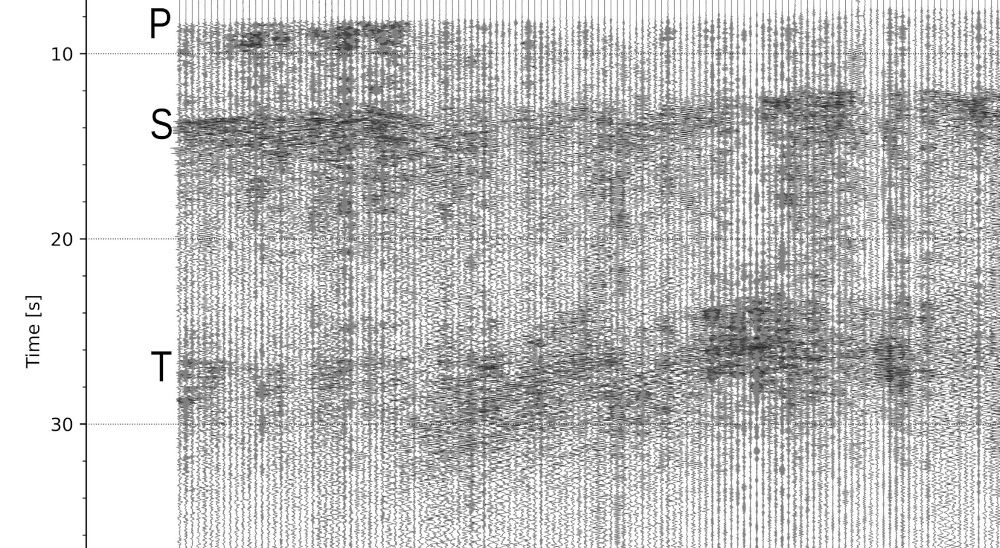
Figures: (Above) T-Waves generated at the Desertas Islands rise from a M2.7 earthquake on 2023/10/27. (Below) Enlarged part of the figure.